
The whole point of this idea is more range between fuel stops. I'd like a removable upper tank for my Tracer 900 GT, sitting where a tank bag normally goes. An adapter replaces the stock cap, a fire-hose-style quick coupling connects the upper tank, and that tank has its own filler cap.
This is a concept for my Brazilian 2022 bike, which follows the older European 2018-onward Tracer 900 GT family. The simple coupling comes with a trade-off: the upper tank needs to be empty before I remove it.
How much extra range?
The standard tank holds 18 litres. Using 20 km/L as a round planning figure, that gives about 360 km on a full tank. Here is what a few possible upper-tank sizes would add:
| Extra | Total fuel | Range | Gain |
|---|---|---|---|
| 3 L | 21 L | 420 km | +60 km |
| 5 L | 23 L | 460 km | +100 km |
| 8 L | 26 L | 520 km | +160 km |
These estimates use the full fuel capacity at the same 20 km/L, before leaving a reserve for a stop. A 5 L upper tank adds about 28% more range on that basis. At 18–22 km/L, those five litres would mean roughly 90–110 extra kilometres.
That is the interesting part for me: a modest upper tank could add around another hundred kilometres without replacing the original tank. The simple calculation is extra litres × km/L = extra kilometres.
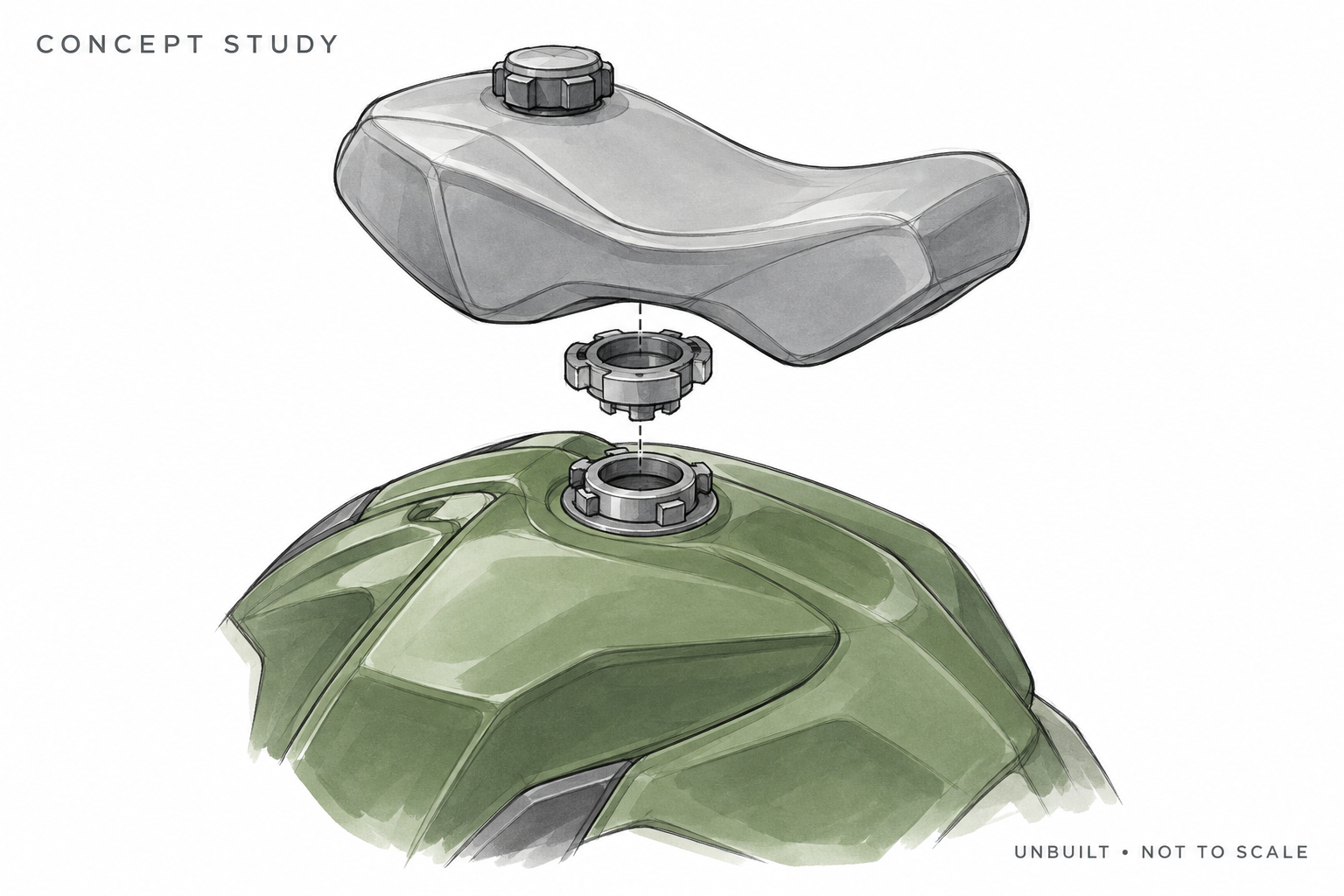
AI-generated concept sketch.
Starting with a tank bag
The first spark was GIVI's Tanklock system: a bag above the tank, easy to lift away, with a purpose-made interface beneath it. Their BF23 flange is listed for European Tracer 900 / GT models from 2018 to 2020, and the ST605+ TanklockED page shows the idea nicely.
The useful part for me is how the bag locks into place and lifts off again. I'd like that convenience for fitting the upper tank before a longer trip and removing it when I don't need the extra capacity.
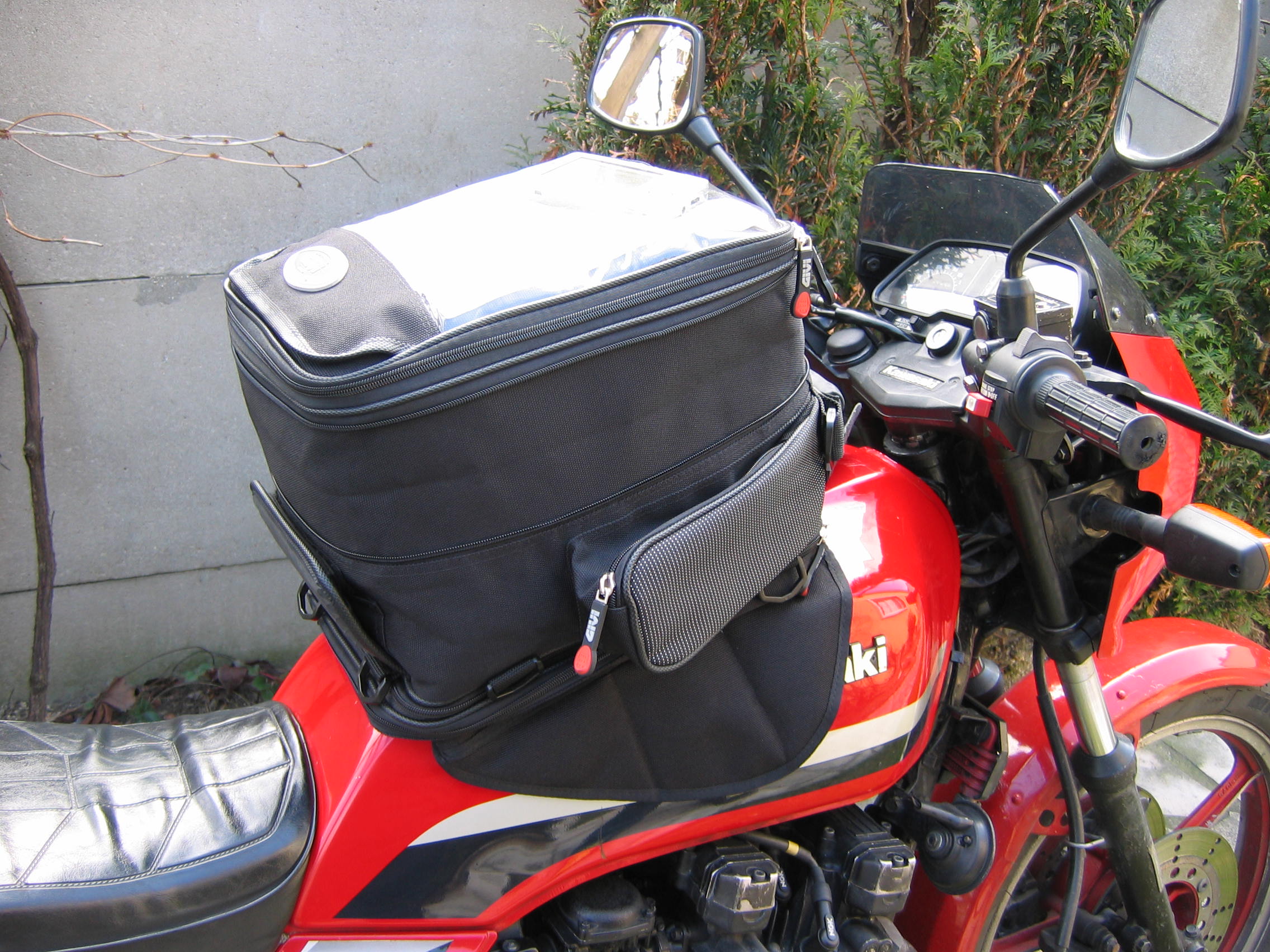
Tank bag on another motorcycle. Photo: Gérard Delafond, via Wikimedia Commons, CC BY-SA 3.0, unchanged.

A familiar-looking old idea
While looking around, I found Delbert William Mundy's US20090101220A1, “Removable auxiliary area fuel tank for motorcycles”, filed in 2007 and published in 2009. It is a close precedent: an upper tank, a sealed connection at the original cap, and its own filler and vent.
The application uses threaded engagement in one version. I am drawn to the quick, positive action of a fire-hose coupling. Its discussion of fastening, fuel transfer, and pressure equalization points straight at the interesting parts.
The pieces in my head
The exploded drawing is how I picture it: stock cap off, an adapter in its place, then the quick coupling and the upper tank with its own cap. The adapter gives it a connection to the original tank; the surrounding support holds the extra weight.
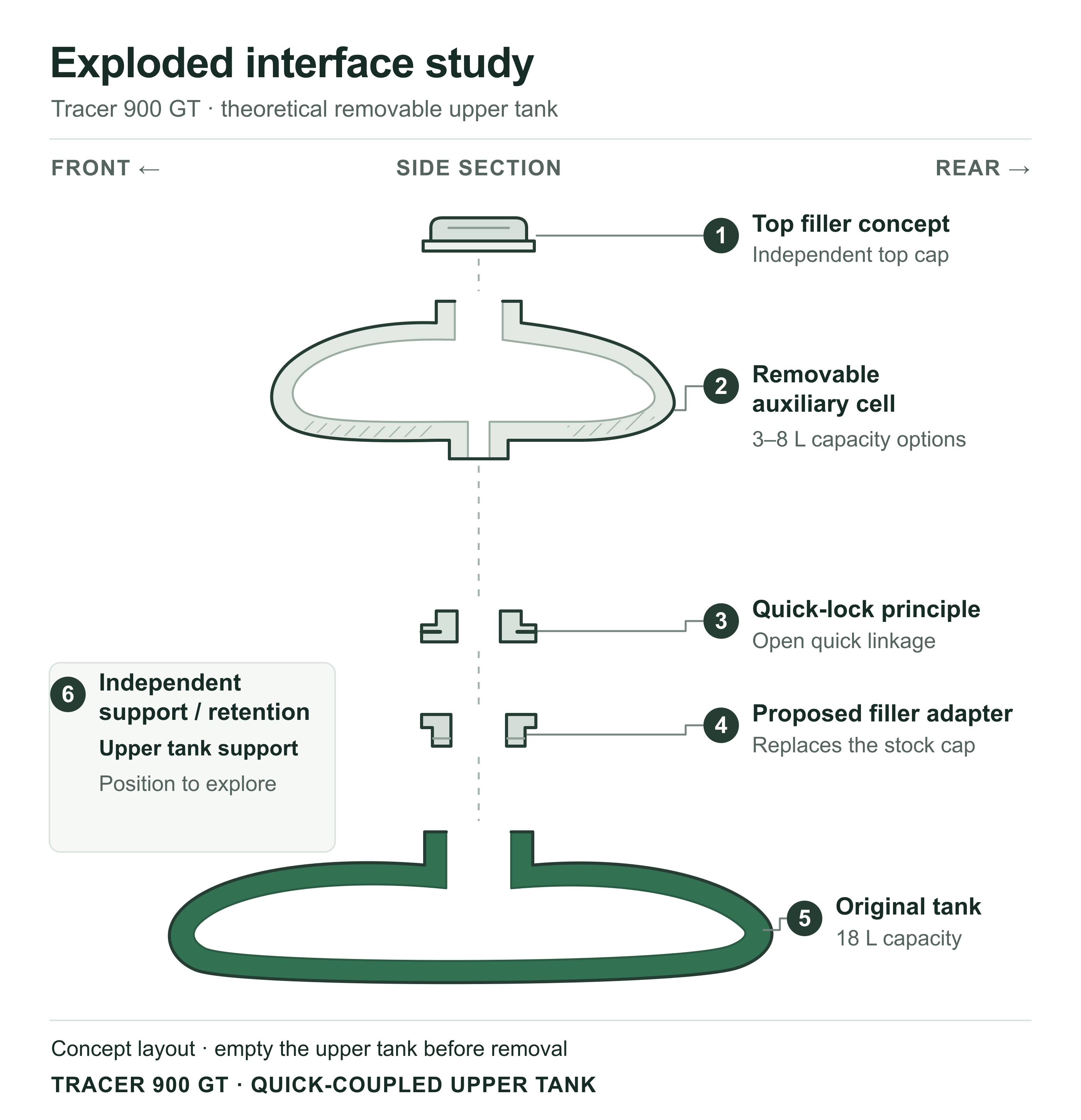
Original concept schematic.
Empty first, then detach
I'm keeping this concept to a simple open quick coupling. It has no automatic shutoff, so I would use up or drain the upper tank before disconnecting it. The quick linkage makes removal convenient once it is empty; it isn't a way to swap full tanks.
Once the upper tank is empty, the idea is to release the coupling, lift it away, and return the original filler opening to a cap. That leaves the bike with its normal tank for everyday use.
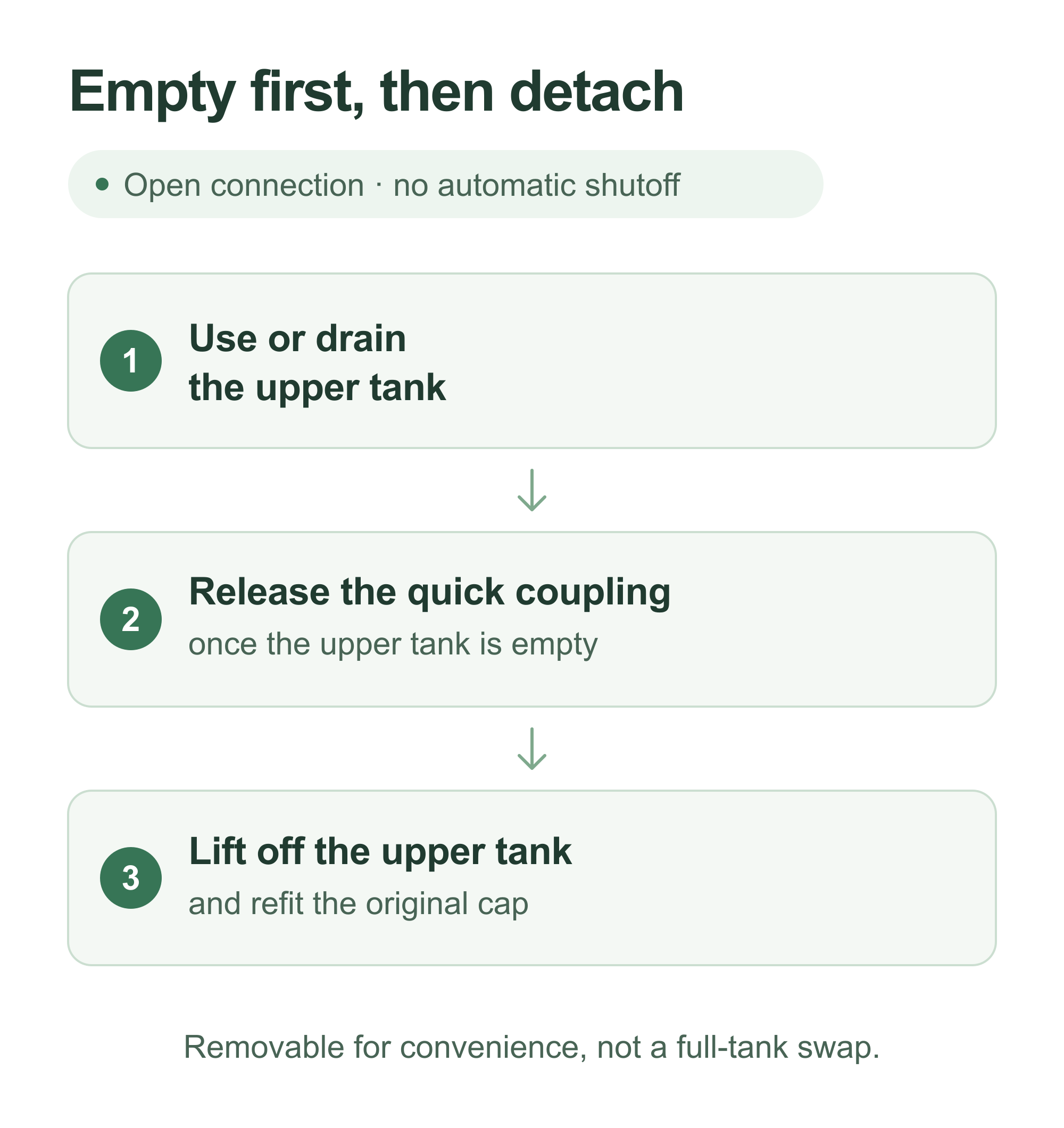
The removal sequence for the open-coupling concept.
Keeping the shape useful
I picture the upper reservoir as an extension of the original tank, with fuel moving down through the connection. The shape still has to leave room for filling and breathing, and the connection needs a proper seal and support.
The other part is how it sits on the bike. Five extra litres need a larger shell than a tiny filler-neck adapter, and that shell shares space with my knees and the bars at full lock. I'd rather explore a low shape that follows the original tank than a tall box in front of me.
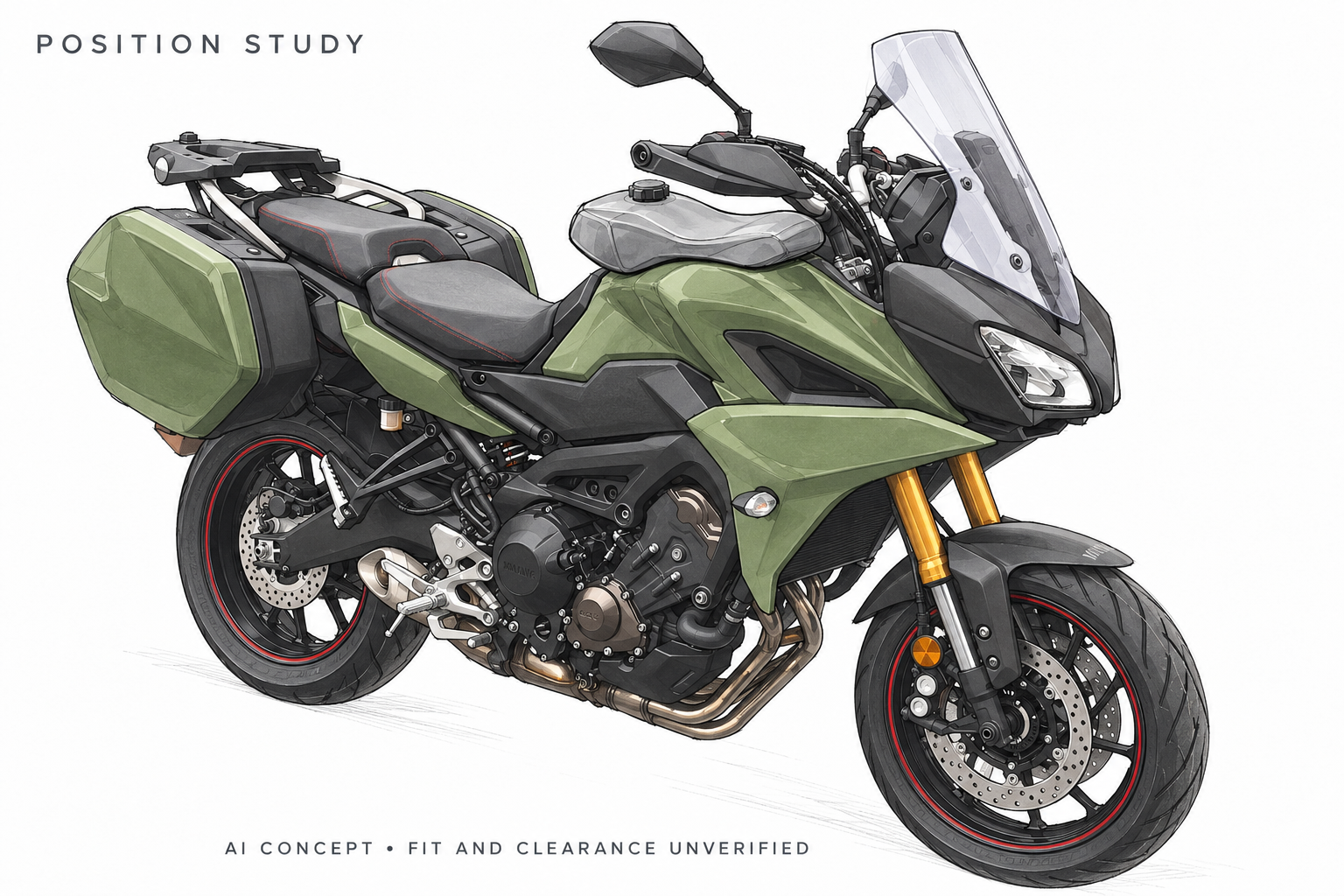
AI-generated positioning sketch, adapted from MicP89's Tracer 900 GT photograph, CC BY-SA 4.0. Green recolour and upper reservoir added; shared under the same license.

A first shape to try
Aluminium, fiberglass, or another material could form the upper tank. At this stage, I'm more interested in its shape, capacity, and how easily it goes on and comes off.
A useful next step would be an empty printed model to try on the bike: turn the bars, sit normally, and see whether the extra volume gets in the way. Then I could compare the 3 L, 5 L, and 8 L ideas against the space they actually take up.
For now, the appeal is straightforward: fit the extra tank for a longer trip, gain more distance between stops, and take it off empty when I want the bike back to its usual shape.